





An Inheritance to Carry Forward: Why I Returned to Browne
October 27, 2026
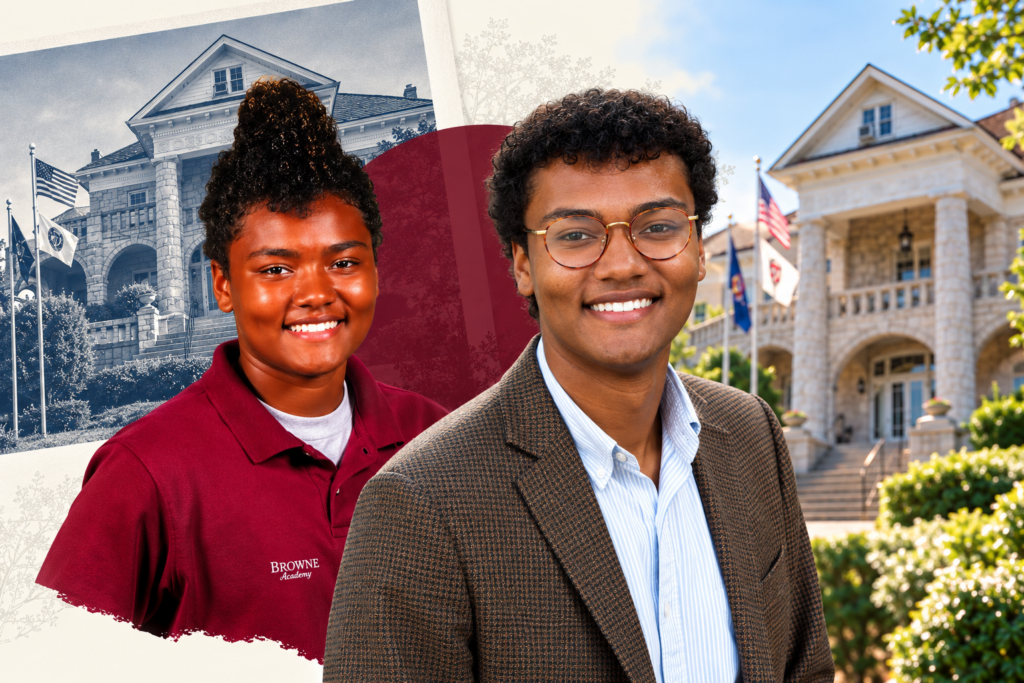
By Bobby Ramkissoon, Browne Academy Alumnus & 7th/8th Grade History Teacher
In this personal reflection, Bobby shares how his education at Browne inspired his path from student to advocate for constitutional freedoms to educator, and why he chose to return to the place where it all began.
On the last day of eighth grade, I gave my history teacher, Mr. Stribling, a small thank-you gift: a t-shirt emblazoned with an American flag and the boast, “Back-to-Back World War Champs.” To my surprise, he in turn had a gift for me: a cloth-bound copy of the Civil War journal written by his great-great-grandfather.
I got the better end of the deal, though it would take me years to understand how much better. Thirteen-year-olds are many things, but connoisseurs of grand gestures they are not. I knew only that he had handed me something that mattered to him. I could not have imagined that years later, that journal would sit on my desk, in my classroom at Browne Academy, where I now teach history to seventh and eighth graders, just a few doors down from where Mr. Stribling taught me.
There is something peculiar about returning to a place that helped make you who you are. The hallways are familiar, the classroom recognizable, but the perspective has changed. For nine years, from kindergarten through eighth grade, Browne was where I learned from others. Now I have returned with the responsibility of teaching them. Somewhere in that reversal lies the reason I came back.
To find it, I have to return to Mr. Stribling’s eighth-grade history class.
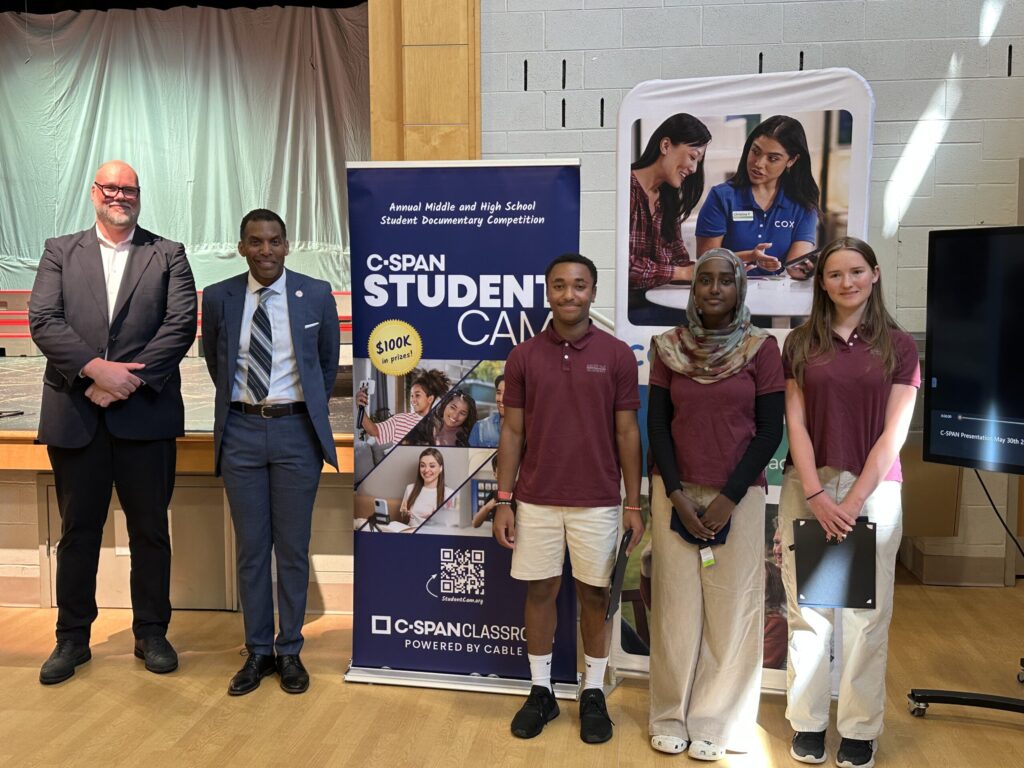
Each year, Browne’s eighth graders participate in the We the People competition, a national civics competition in which students defend their understanding of the Constitution before panels of judges in simulated congressional hearings. My team was assigned the First Amendment. We spent weeks studying its principles, constructing arguments, and anticipating questions.
Then came the hearing. Our prepared remarks ended, the judges began asking questions, and the safety of a rehearsed answer disappeared. I remember discovering that I had something to say. Faced with a question I had not anticipated, I could draw on what I had learned, reason through the problem, and defend a position of my own. The Constitution, which had previously seemed a distant collection of provisions and precedents, suddenly became something alive: a set of arguments about how free people ought to govern themselves.
It was a small moment by most measures. For me, it changed the direction of my life.
My interest in the First Amendment and free expression that began at Browne carried me into high school debate, collegiate moot court, graduate school seminars, and eventually to the Foundation for Individual Rights and Expression (FIRE), where I worked to defend the constitutional principles I had first encountered in eighth grade. I intended to become a First Amendment attorney. Teaching, if I considered it seriously at all, was something I might take up decades hence; a genteel coda to a distinguished and, one hoped, lucrative career in the law.
But plans, as the saying goes, are what life ignores. While at FIRE, I was unexpectedly confronted by a question that constitutional law alone could not answer. A free society depends on more than the legal protection of speech. It also depends on citizens capable of exercising that freedom responsibly: people willing to entertain an opposing argument, distinguish evidence from assertion, and recognize that disagreement need not imply bad faith. The First Amendment protects our right to speak. It does not teach us how to think.
That work belongs, in no small part, to education. James Madison, who knew a thing or two about constitutions, said that “a well-instructed people alone can be permanently a free people.” So I decided I had to return to Browne.
I began to reconsider what had actually happened in Mr. Stribling’s classroom. The enduring lesson of We the People was not simply what the First Amendment said or did. It was the experience of being treated as someone capable of understanding and defending serious ideas. My teachers had expected more of me than I knew to expect of myself, and in doing so had enlarged my sense of what was possible.
That was Browne’s particular gift.
At an age when confidence is often fragile and intellectual curiosity easily discouraged, Browne’s teachers made both feel worth cultivating. They gave us room to ask questions and the expectation that we would eventually find our own answers. Their confidence in us often preceded our confidence in ourselves.
I now teach students who are roughly the age I was when an eighth-grade history lesson unexpectedly became a vocation. My students study civilizations, revolutions, constitutions, and the consequential decisions of people long dead. But history, at its best, is not merely the acquisition of knowledge about the past, any more than baseball is the accumulation of box scores. It is an education in judgement. To understand another age requires recognizing that people can act rationally from assumptions we do not share, that good intentions can produce disastrous consequences, and that certainty is often easier to acquire than wisdom.
These are difficult lessons, particularly for young people beginning to form their own convictions. They are also indispensable ones.
I do not expect every student to leave my classroom with a passion for the First Amendment. Education ought to expand the range of possibilities a young person can imagine, not prescribe the one he or she must pursue. What I hope is that each student encounters a moment when an unfamiliar subject becomes unexpectedly personal, when curiosity turns into commitment, and when something once thought beyond reach begins to look possible.
Teachers rarely know when such moments occur. They may happen in the middle of an ordinary lesson or during a conversation after class. Their consequences may not become apparent for years, if ever.That uncertainty is part of the peculiar faith teaching requires. We invest in people whose futures we cannot foresee, trusting that something of what we offer will accompany them into lives we will never fully witness.
It is also why coming back to Browne matters so much to me. I have the opportunity to contribute to the same community that shaped my intellectual life, to extend to another generation of Bruins the attention, encouragement, and trust I once received. What I was given here was never simply an education to complete. It was an inheritance to carry forward.
I think often about the journal Mr. Stribling gave me on that last day of eighth grade. At thirteen, I saw it as a generous gift from a beloved teacher. Today, sitting a few doors down from his old classroom, I understand it differently. He was sharing a piece of history that had been entrusted to him, perhaps hoping that a student who had come to love the subject would find something worth preserving in it.
I cannot know what my own students will remember of our time together, or what seemingly ordinary classroom moment might remain with them long after they leave Browne.
Mr. Stribling could not have known, either. But his gift is still on my desk. And I am here.